
What is tax?
Explanation – tax is a fee (financial charge) that the government collects from you. it is a legal payment taken by the government for the services it provides to us(public/citizens).
What facilities does the government provide us for which we pay taxes ?
- The government establishes a defense system for the security of the country. That is the army, navy, air force, etc. the expenses come from the tax we pay.
- Government hospitals and other medical services, such as government health insurance, etc.
- The road we use is also one of the facilities provided by the government.
- Government educational institutions, schools and research institutes are the foundation of the country’s progress.
- Government space agencies such as India’s ISRO , Japan’s JAXA , and America’s NASA.
- Police, fire brigade, garbage collection, street lights, and much more.
- Power generation, electricity supply, Government Transport Board(S.T. Services), Railways and other transport services
- Government bank, postal service.

The government can provide many such essential services with tax money.
We pay many taxes like Goods and Services Tax ( GST ), Income Tax, Property Tax, Water Tax, Sanitation Tax. But Who collects taxes, i.e. Central Government, State Government or Municipality…
Based on the type of tax, we can understand who collects which type of tax. So let’s look at taxes and their types…
Types of taxes :
There are two main types of taxes-
1. Direct tax
2. Indirect tax
Direct tax – This tax is collected directly from an individual or an organization. This tax is collected directly from that individual on the basis of his annual income or on the basis of his wealth. A company or other organization also comes under this tax .
Example of direct tax:
- Income Tax-
- This tax is levied based on how much money a person earns. Those who earn more pay more tax and those who earn less pay less tax.
- Currently (in India, in 2025) if you have an annual income of Rs 12 lakh or less, you do not have to pay a single rupee in income tax.
- Corporate Tax-
- This tax is levied on the net profits of companies. In India, companies have to pay corporate tax at the rate of 25 percent of their profits. Foreign companies that are present in India have to pay the same tax at the rate of 35 percent.
- Property tax-
- The tax levied on your house, buildings, etc. A larger house has to pay more tax and a smaller house has to pay less.
- The long-term capital gains tax on the profit we earn on our capital is called LTCG (Long Term Capital Gains Tax). Now in India, the LTCG is 12.5% in 2025.
- We pay LTCG tax on the profit we earn on our capital in the stock market after a year.
- STCG tax has to be paid on the profits made in the stock market a year ago.
- Agricultural income tax is levied on income from agriculture .
Indirect tax – This tax is not based on how much money a person earns, but on what goods a person buys. This tax is not collected directly from an individual by the government, but from the seller to the customer , then from the merchant to the seller, and finally this tax reaches the government.
Example of indirect tax:
- GST (Goods & Services Tax) –
- We pay this tax to the government on all the goods we buy. We also pay GST on the services we buy, like doctor’s fees, car servicing, etc.
- Entertainment tax-
- Watching movies, etc.
- Value Added Tax (VAT) –
- We pay this tax when we buy petrol and diesel. This tax is levied when we buy alcohol and related products.
- Excise duty –
- Tax levied on goods produced in a factory/company. This tax can be levied on the production of any substance.
We have seen the types of taxes and their examples, now let us understand who collects what type of tax, i.e. the central government, the state government or the municipality –
| Central government | state government | Municipality/Gram Panchayat |
| Income Tax | income based on agricultural production | Property tax |
| Custom duty – tax on imports | State excise duty | Water bill, cleaning tax |
| GST (Goods & Services Tax)– CGST and half of the IGST is collected by the Central Govt. | SGST in GST- is collected by the state government(s). state government also collects half of the IGST. | Professional Tax |
| LTCG (Long Term Capital Gains Tax | Value Added Tax (VAT)- on alcohol, petrol diesel | Other administrative fees |
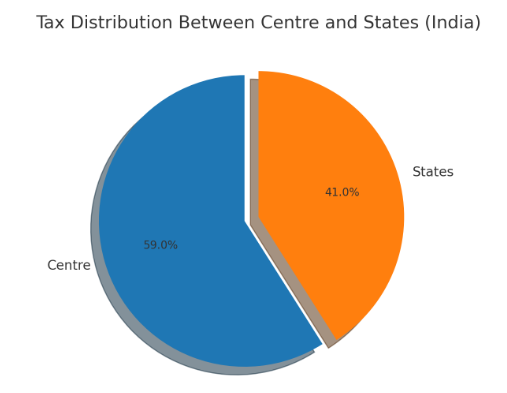
The largest share of the taxes we pay goes to the central government. The state government has control over taxes in the state. Local self-government bodies like municipalities, municipal councils, and gram panchayats depend heavily on the state and central governments for funds.
The Finance Commission of India decides how the country’s tax money will be distributed between the central government and the state governments. This tax distribution formula changes every 5 years.
the total tax collected by the central Government of India in year 2024-25 is Rs.25,56,959.57 crore (289663423728 USD)–source: Govt.of India
what is million, billion, trillion ?
follow us on
1 thought on “Tax …”