This article is the continuation of the previous one, in which we discussed the categorization of the mutual funds. SEBI has categorized the mutual funds into 5 main categories.
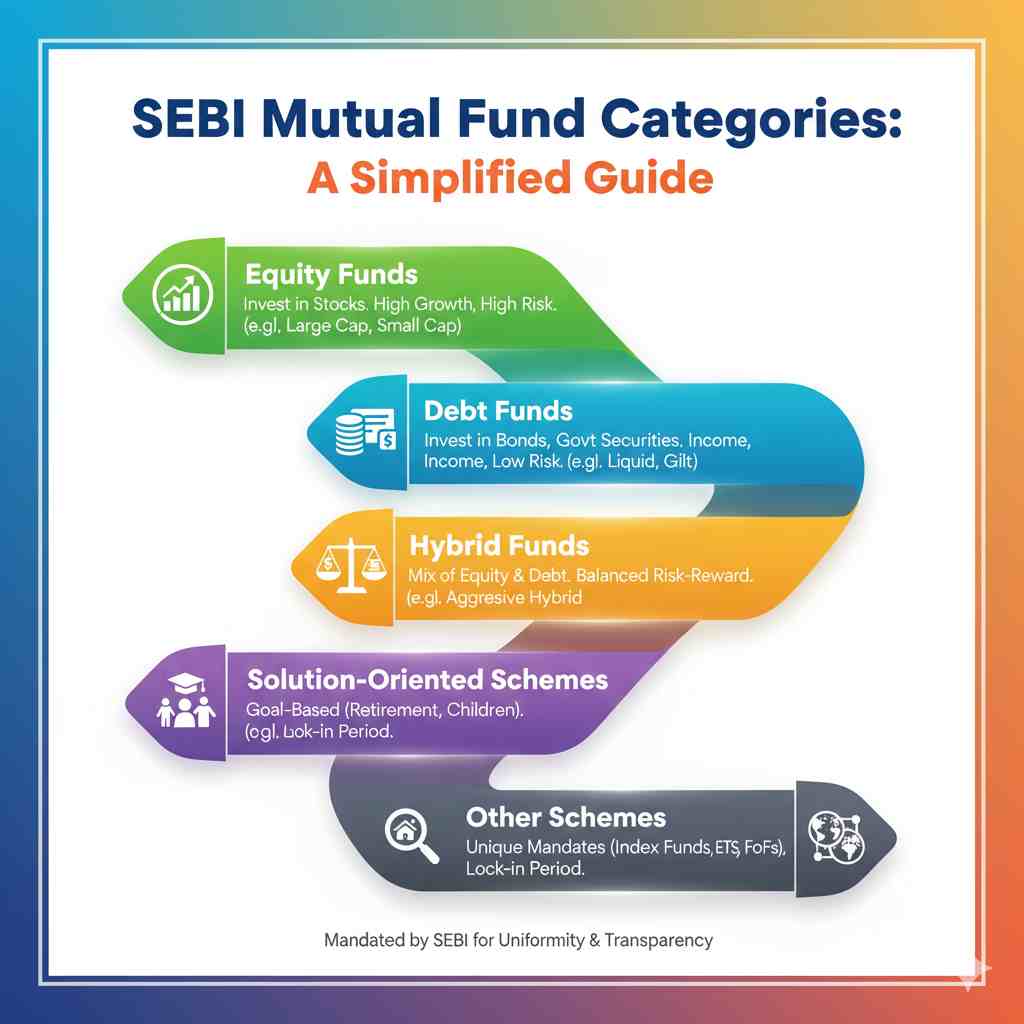
We have read about the most popular type of mutual fund, i.e. equity funds. Going further, we will discuss the remaining types of mutual funds.
Read👉 Types of mutual funds – Part 1
Visit official website ➡️ SEBI MF categorization
Categorization of mutual funds
Debt funds –
Debt funds are not directly related to the stock market. When a mutual fund primarily invests in the bonds and other debt securities, it becomes a debt fund.
Bonds and securities represent a commitment to repay the invested capital with interest upon maturity, thereby constituting secure investment choices.
Read ⇾ What is a debt instrument ?
The investment in bonds, government securities and other debt instruments is like giving a loan to these bond issuers. When a company needs funds or money, they have options such as issuing shares, taking a loan from banks, or raising money through bonds, etc. When we invest in their bonds, we give them a loan.3
The debt funds invest in long-term and short-term bonds, debentures, G-sec, etc.
A government issues Government securities when it needs funds. The G-sec bonds are the safe investment among all of these investments.
👇
Sub-categorization of debt mutual funds –
The SEBI has categorized the debt funds into sixteen types. Here, we will discuss only a few of them, as many of these types are similar to each other. The types are based on maturity period, who issued the bonds, short-term, long-term and mid-term funds, etc.
What is maturity period ? = maturity period is a time period up to a specific date at which the investment amount is returned to the investor. The interest earned is also returned to the investor.
- Overnight debt fund –
- The overnight debt funds invest in securities with maturity of only 1 day.
- Liquid debt funds –
- These funds invest in the securities with maturity of up to 91 days only.
- Low duration debt funds –
- These types of funds invest in securities with maturity of 6 months to 12 months.
- Money market debt funds –
- These funds invest in money market instruments. The maturity period is less than a year.
- The short term investment is low risk and it is highly liquid.
What is money market ? ⇾ Money market is a marketplace where the lending and borrowing takes place for short-term duration (i.e. less than a year).
- Corporate bond funds –
- Corporate bonds are issued by the companies to raise funds. This category of MFs is required to invest at least 80% of their assets into AA+ and above rated corporate bonds.
- AA+ is a rating of an asset or bond, stock, etc. BB, BB+, AA, etc. are some other ratings which are lower ratings compared to the AA+ rating.
- The maturity of these bonds depends on the type of the scheme.
- The duration of the maturity varies from less than 1 year to 10 years or even more.
- Corporate bonds are issued by the companies to raise funds. This category of MFs is required to invest at least 80% of their assets into AA+ and above rated corporate bonds.
Also read ⇾ What is a bond ?
- Banking and PSU funds –
- At least 80% of the investment of the fund goes towards the debt instruments of banks and public sector undertakings (PSUs).
- These funds also purchase municipal bonds under these schemes. When a municipal corporation needs money, the corporation issues municipal bonds.
- Gilt funds –
- The 80% of the investment must be in the Government securities (in all maturities).
- G-securities = gilt edge securities because of the high rating and low risk.
Hybrid funds –
Whenever the word hybrid comes, it means it is the combination of two or more things.
In the context of mutual funds, these hybrid funds are a type of mutual funds that invest in both equity and debt instruments. Hybrid funds give us the choice of going with risk and stability at a time.
This means, the hybrid funds buy/invest in both shares and bonds. This is a balanced approach that gives us growth with stability in returns.
SEBI has categorized these hybrid funds into 7 categories –
- Conservative hybrid fund –
- This type of hybrid fund plays safe.
- They invest 10% to 25% in equity and 75% to 90% of their funds in debt instruments.
- Aggressive hybrid funds –
- These type of hybrid funds are opposite of the conservative hybrid funds. The aggressive funds invest more in equity and less in debt instruments.
- Investment = 65% to 80% investment in equity and 35% to 20% in debt instruments.
Also Read 👉 What is SIP ?
- Balanced hybrid funds –
- As the name suggests, the balanced hybrid fund invests with the balance between equity and debt instruments.
- Investment = 40% to 60% in equity and 40% to 60% in debt instruments.
- Dynamic asset allocation funds –
- There is no fixed allocation of investment in equity or debt instruments.
- The fund manager or fund house can change asset allocation dynamically, based on the market conditions.
- Investment = 0% to 100% in equity and 0% to 100% in debt instruments.
- Multi asset allocation –
- These funds invests in at least 3 different assets.
- Each asset class must get at least 10% of total investment.
- Arbitrage fund –
- Investment = at least 65% investment should go towards equity and related instruments.
- Arbitrage is a trading strategy. A fund house buys assets from a cheaper market and sells it where it is more expensive.
- Equity savings fund –
- At least 65% investment in equity.
- Minimum 10% investment in debt instruments.
Solution Oriented Schemes –
The pooled investment of the investors is directed towards a specific goal that investors desire. These mutual funds have a lock-in period.
What is Lock-in period ? ⇾ Lock-in period is similar to maturity period. When we invest in a mutual fund, there is a time period until which we can not withdraw our investment from that fund. This time period is called as lock-in period.
We can withdraw our invested amount from a mutual fund at any time, but if we withdraw it before the lock-in period, we need to pay a fee called as exit load.
There are 2 solution oriented schemes –
- Retirement funds –
- The goal of the fund is described in its name.
- Lock-in period = at least 5 years or until retirement age, whichever is earlier.
- Children’s fund –
- Lock-in period = at least 5 years or until a child completes 18 years of age, whichever is earlier.
Other Schemes
- Index funds and ETFs –
- The index such as Nifty-50, Sensex, etc. are tracked by these funds.
- The performance of these funds depends upon the performance of the index they are tied to.
- e.g. A Nifty-50 index fund will mimic the performance of the Nifty-50 index.
- Investment = at least 95% of the total assets in the securities of that particular index.
- Fund of funds –
- This type of mutual fund invests in other mutual funds. That’s why it is called as fund of funds.
- Investment = at least 95% investment in the underlying mutual funds.
In this post, we discussed the categorization of mutual and the sub-categorization of MFs. This will help you choose a fund to invest according to your needs.