
The Monetary Policy Committee of the RBI is the decision-making body regarding the RBI’s benchmark rates, the Repo rate and the bank rate. The monetary decisions taken by the RBI shape the short-term and long-term growth scenario of our economy. The key benchmark rates decide/influence the interest rates of the banking sector.
Visit the RBI official website = RBI’s MPC – structure
The RBI got the mandate to tackle inflation since 2016. In 2016, the RBI Act was amended, and it becomes the duty of the RBI to target inflation. The central bank gets the autonomy to use of monetary policy tools.
Monetary Policy Committee (MPC)
Establishment of the RBI in 1935 ⇾ and nationalized in January 1949. The role of RBI as a central bank began in 1949. Since then, RBI has regulated the banking and financial sector of India.
In 2016, The Parliament of India amended the RBI Act, 1934. The amendment established the Monetary Policy committee and gave it a statutory status. A statutory body means a body/agency which is created by an act & gets its powers from that act.
The amendment provided the RBI with the duty to target inflation in the economy within a particular range. Until now (December 2025), the inflation target is 4% with a plus or minus 2% range. This mandated inflation range is from 2% to 6% which is RBI’s target band.
Which type of inflation ?
The Consumer Price Index (CPI) is the key index that the RBI’s MPC follows to decide on inflation targeting. The 2% to 6% range is regarding the CPI inflation. As the CPI includes services and goods both and tracks the prices at the consumer’s level or retail levels, it helps better understand the inflation scenario in the economy.
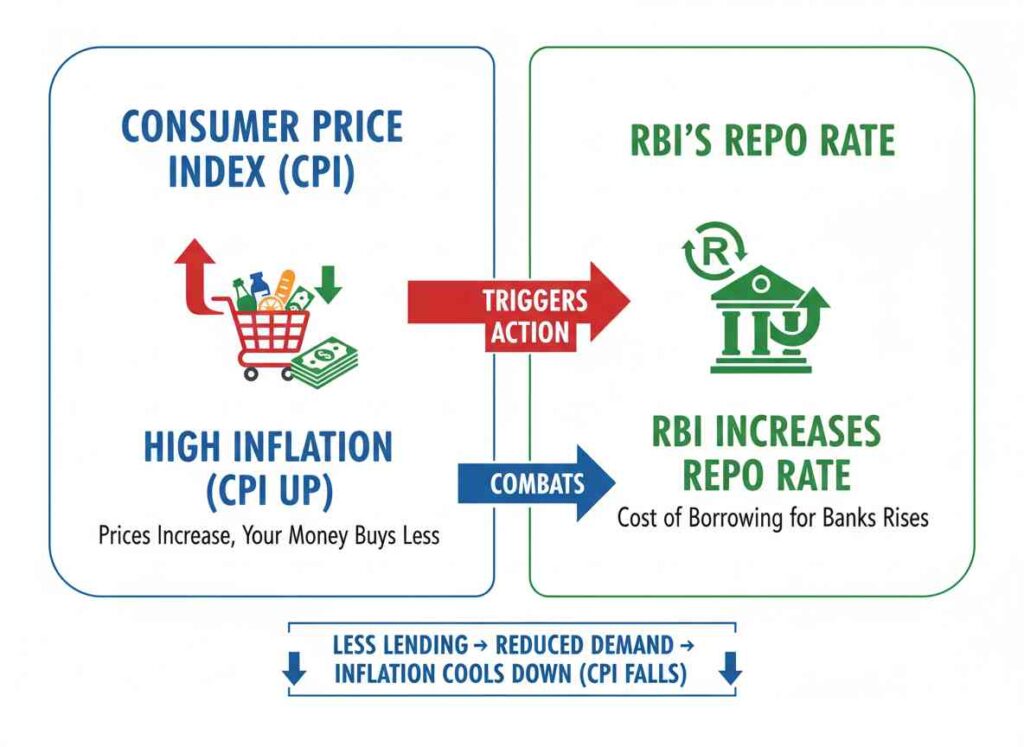
The WPI (Wholesale Price Index) on the other hand only considers the goods and excludes the services while tracking inflation. The WPI calculates inflation at wholesale level only. That’s why the RBI uses CPI inflation while taking policy decisions.
Read about ➡️ CPI and WPI inflation indices
The Monetary Policy Committee – Structure & Process
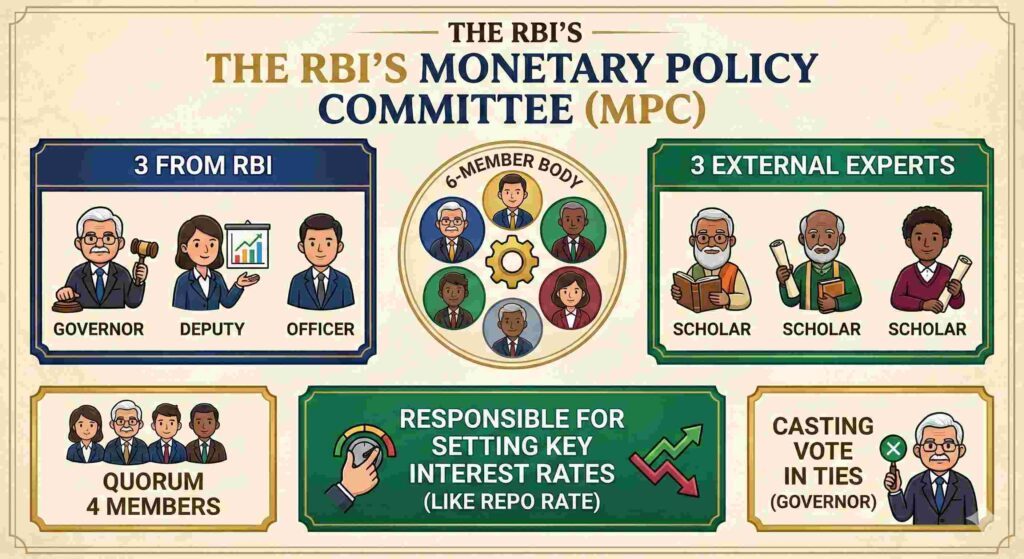
The RBI Act, 1934, after that amendment, provided an empowered six member committee called MPC (Monetary Policy Committee). The MPC is a statutory body and has autonomy regarding the monetary policy decisions.
The structure
The Government of India constitutes the MPC. In September 2016, the first such MPC came into existence. Right now, the committee has 6 members, with the RBI governor as its chairperson/head.
- RBI governor as its chairperson/head.
- The deputy governor of the RBI, who is in-charge of monetary policy, is the member of the MPC.
- An officer of the RBI nominated by the RBI central board.
- Three external experts appointed by the Government of India are part of the MPC for a 4 years term.
- The ‘external’ members ⇾ because they are not the official members/officers of the RBI. The Govt. of India appoints them to provide their expertise.
- There is no renewal of their term. Once over, it’s over.
The Monetary Policy Process
The RBI has notified the MPC process regulations in 2016.
The MPC usually meets every two months and decides the RBI’s benchmark rates by voting. The committee has a quorum of 4 votes. In case of a tie, the vote of the RBI governor is considered as the casting vote.
- The schedule of the meetings is published in advance, and it is available in the public domain.
- The resolution of the meetings is publically released after the meeting is concluded.
- The Monetary Policy Department assists the MPC and helps them in the preparation of the monetary policy.
- The MPC reviews various surveys conducted by the RBI and also reviews many such reports and data to formulate the monetary policy.
- The RBI publishes the resolution adopted by the MPC, and the resolution includes the changes in key Repo rate.
- The MPC decisions are released publically by a press conference.
- The RBI also publishes the report about the MPC decisions in detail on the 14th day from the day of the meeting.
- The RBI publishes the monetary policy report every six months. The report contains
- The inflation dynamics of the previous six months.
- The near term outlook of inflation.
- The state of the Indian economy, the financial market and stability, external economic situations, etc. these conditions can potentially influence the monetary decisions of the RBI and that’s why it is important.
Instruments of Monetary Policy
- The Repo rate 👈 What is a Repo rate?
- Standing Deposit Facility (SDF) rate
- Marginal Standing Facility (MSF) rate
- Reverse Repo rate
- The Bank rate
- Cash Reserve Ratio (CRR)
- Statutory Liquidity Ratio (SLR)
- Open Market Operations (OMO) = Buying and selling of Government securities by the RBI.
The RBI’s Monetary Policy committee plays a key role in maintaining the price stability in the economy. The primary objective of the monetary policy is to maintain the price stability and keep in mind the objective of growth ⇾ According to the preamble, RBI Act.