
GST in detail –
In GST part 1 we saw what GST is and its basics. goods and services tax is an indirect tax levied on the purchase and sale of goods and services . Now let us learn a little more about goods & services tax.
which ministry collects it?
Finance Ministry of the Central Government collects the it as CGST. While the state governments deposit SGST in their treasury accounts.
Who gives the government the right to collect taxes?
The Constitution has given the power to levy taxes to the governments. According to Article 279A of the Constitution, the government gets powers regarding GST. The President of India constituted The GST Council using powers under the Article 279-A of the constitution.
Center and State: GST Distribution
In part 1 we saw that central and state governments share GST 50-50. So which state government actually receives GST?
GST is a destination-based tax. consumer state recieves GST i.e. where customer uses the final product. central government receives half of GST in any situation.
These are not the types of GST but parts of the GST –
- Central Goods and Services Tax (CGST) –
- Central Government takes the CGST.
- State Goods and Services Tax (SGST) –
- state government takes the SGST.
- Integrated Goods and Services Tax (IGST) –
- at first central govt. collects IGST. half of the IGST goes to the consumer state i.e. the state in which customer baught the item for consumption.
- Union Territory Goods and Services Tax (UTGST) –
- Union Territory collects UTGST. That is, UTGST goes to the account of the Central Government/Union Territory.
CGST
- CGST and SGST are levied together. it is levied when goods are manufactured in one state and are consumed in the same state.
- Both CGST and SGST have the same percentage.
- Eg.-
- If an item is worth Rs.100 and there is 18% GST on it. That means the MRP of that item will be Rs.118. In that 18% there is 9% CGST and 9% SGST.
- CGST is levied when goods are manufactured in one state and sold in the same state.
- CGST is deposited directly into the central government account.
- For example-
- Goods from Gujarat were sold within Gujarat. SGST will go to Gujarat. CGST to the Central Government.
- Goods from Odisha were sold in Odisha itself. SGST will go to Odisha. CGST to the Central Government.
SGST
- When a product is manufactured in a state and sold in the same state, both SGST and CGST are levied.
- the situation for CGST & SGST is same.
- Both SGST and CGST have the same percentage.
- Eg.-
- Suppose there is 12% GST on an item, then it has 6% CGST and 6% SGST.
- This only happens when the product is made in one state and sold in the same state.
- SGST is deposited directly into the state government’s account.
- Eg . –
- Goods from Gujarat were sold within Gujarat. SGST will go to Gujarat. CGST to the Central Government.
- Goods from Odisha were sold in Odisha itself. SGST will go to Odisha. CGST to the Central Government.
UTGST
- UTGST is levied when a good is manufactured in a Union Territory and sold in the same Union Territory.
- Just as state governments levy SGST on the purchase and sale of goods within that state, Union Territories levy UTGST.
- CGST is levied along with UTGST. But SGST is not levied in this case.
- Both UTGST and CGST have the same percentage.
- Eg.-
- Suppose there is 12% GST on an item, then it has 6% CGST and 6% UTGST.
- This only happens when the goods are manufactured in a Union Territory and sold in the same Union Territory.
- Union Territories :
- The central government runs the government. Such regions do not have the status of states.
- Goods from Chandigarh were sold in Chandigarh itself. UTGST will be paid to Chandigarh . CGST to the Central Government.
IGST
- When goods are manufactured in one state and sold in another state, only IGST is levied. There is no separate CGST and SGST/UTGST in this case.
- IGST is collected by the central government and then half of that IGST is paid to the state where the goods are purchased&consumed.
- Eg.-
- Suppose IGST on an item is 18%. Then the Central Government will get 9%. And the state where the item is consumed will get 9%.
- This happens when goods are manufactured in one state and sold in another state, only then IGST is charged .
- And even when the goods are manufactured in one Union Territory and sold in another Union Territory /State , only IGST is charged .
- Eg.-
- When an item is made in Gujarat and sold in Maharashtra, IGST will be levied. Half of this IGST will be received by Maharashtra. And the other half will be received by the Central Government. Gujrat will not get GST in this case.
According to the above information, we can understand that CGST and SGST are levied together. Because the situation for CGST-SGST is the same. And that is, when the goods are manufactured in one state and purchased and sold in the same state, then CGST-SGST are part of GST.
Something similar happens with UTGST. CGST and UTGST are levied together. When a product is manufactured in a Union Territory and sold in the same Union Territory, then UTGST- CGST are two equivalent parts of the GST.
That is, in both the situations, the central government gets half of the GST. That is, CGST.
When does IGST apply ?
1. When a product made in one state is sold in other states.
2. When a product manufactured in one state is sold in a union territory.
3. When a product made in one Union Territory is sold in another State.
4. When a product manufactured in one Union Territory is sold in another Union Territory.
Even in the case of IGST, the Central Government gets half of the GST. The State which produces the goods does not get half of the IGST. State or Union Territory which consumes the goods gets half of the IGST.
Total GST collection in the government treasury?
The total GST collection in the country in the financial year 2024-25 was Rs.22.08 lakh crore (Central and State Governments combined) . average of ₹1.84 lakh crore GST was collected in a month – source: Government of India .
GST for the month of August 2025 has reached Rs.1.86 lakh crore – source: DD News . This money wii be spent on various development works in the country.
GST has benefited states like Maharashtra and Uttar Pradesh because more goods are sold in these states. And the state that consumes more goods gets more GST.
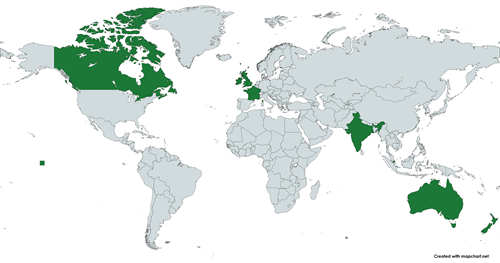
Which other country has a tax system like GST?
Indirect tax systems similar to GST have existed in other countries of the world for many years. Such as-
- In Australia, most goods and services are subject to 10% GST. Some goods are subject to GST higher/lower than 10%.
- Canada has a system similar to GST called the “Federal Goods and Service Tax”.
- England (UK) has a VAT (Value Added Tax) system.
- Singapore has GST.
- New Zealand also uses the GST system.
- France was the first country to implement GST.
follow us on