stages of development of an economy ➡️ Usually, every system goes through multiple stages of development. The stages of development mark many changes as well as many transformations. These changes make progress and develop that system in such a way that it helps us and makes our lives easy.
An economy is also a system that has undergone many years of transformation and changes. An economy, in my opinion, basically runs on the principles of human behavior. We humans have developed a system that helps us to make our lives better organized. We created markets, currency, money, tax, fees and materialistic things like that.
Stages of development of an economy : Evolution of Money –
Early Economies (Ancient & Medieval)🌽🌾🐄🏇
Imagine the Stone Age, when we human beings used to live in forests and caves. There was no concept of economy or money in the Stone Age. The only thing we humans were concerned about was survival. The concept of money, trade or a system to carry on stuff like that did not exist.
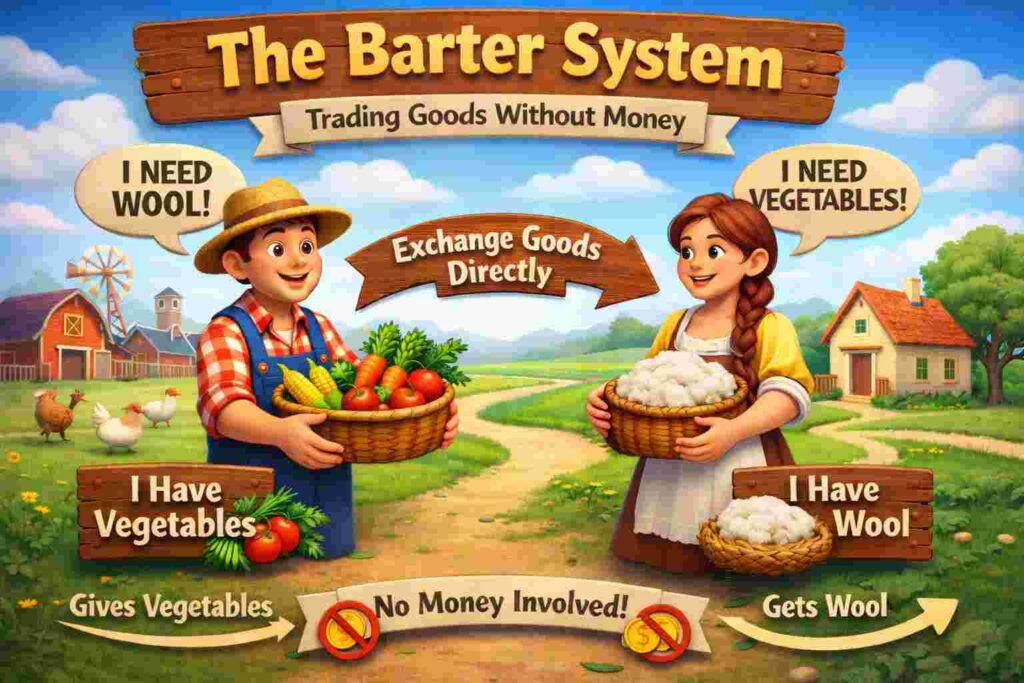
What is ‘Barter System’ ? ⇾ This is the ancient system of exchange, where people trade goods for other goods. The exchange of things between persons who want goods in exchange for other goods. The system also traded services for the exchange of other services or goods.
- Example =
- A person wants apples in exchange for, let’s say, wheat or rice.
- Wool in exchange for a bull.
- A singer got a lot of grains for his/her art from a king/queen.
Go through ➡️ NCERT Chapter – Money and Credit
Humans progressed, we moved towards social life from wild life. We started living in colonies/groups, made societies based on certain norms. We learn agriculture and produced what we need to eat. As agriculture progressed, the produce increased, and we began to produce more than our needs. The excess production of food grains, vegetables, etc. opened the doors for ‘trade’. Trade of goods began, these trades were based on the barter system. The barter system evolved gradually, and trade of finished goods like cloths (made of different fibers), jaggery (made of sugarcane), etc. started.
To store the excess produce, storage facilities were built. Some towns/colonies became trade centers where most of the goods were sold and bought. And this is how a civilization develops gradually.
From forests and caves to a civilized society that has agriculture as its main profession and has trade centers, the early economies developed over a period of time. The early economies followed the barter system for trade and other settlements.
Stages of development of an economy – Beyond the Barter System
The barter system has many drawbacks and problems. The major problem with the system is that it has a ‘double coincidence of wants.’ That means, in an exchange, both the persons/parties must have what they want in exchange for their goods. If a person does not have something that I want in exchange for my good, then such trade/exchange is not possible.
- Example –
- I want apples in exchange for wool, but the person interested in trade do not want wool, he wants pot to store water.
- Both the persons interested in trade want something in exchange for a same thing they have. Such a trade will not take place.
- The barter system has many problems, like it was difficult to calculate the values of different things in exchange for goods/services. So, calculating the value of goods in comparison with the exchanged goods was a big problem.
- Storing the goods that we got in exchange for our services/goods was also a huge problem.
- Especially, perishable goods.
- The payments that we promise for the future are difficult to make. The calculation of future payments gets hard when it comes to the barter system.
- e.g. In future the quality or the type of goods may change, so it is difficult to make any promise.
- A contractor pays wages of workers in the form of 5Kg wheat. But at the time of payment the quality of wheat was very bad, but the weight was 5Kg as it was promised.
Also Read 👉 The sectors of an economy
What next ?
The limitations of the barter system gave rise to the concept of ‘commodity money’ as the medium of exchange. Some commodities, that were widely accepted, were considered as the medium of exchange for trades. Cows, sheep, cattle, grains, salt, metals, shells (kaudi), etc. were widely accepted as a medium of exchange.
The price/value of these commodities was still negotiable, and the confusion remained as it was in the old barter system.
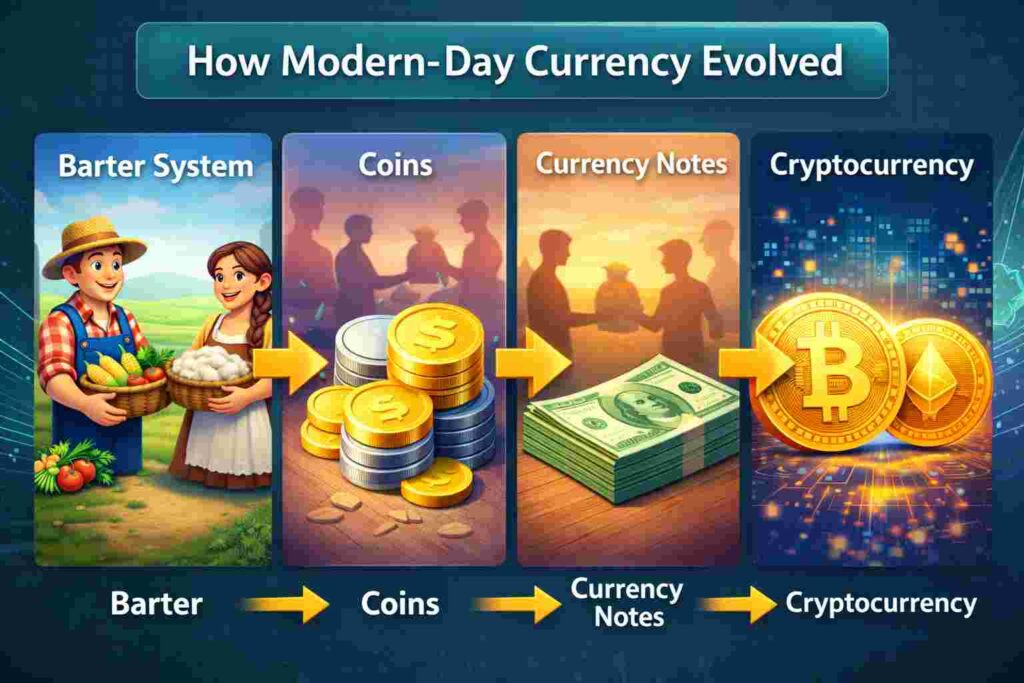
The ‘barter system’ and ‘commodity money system’ have many limitations, thereafter came the age of coins. The use of metallic coins began around 650 BCE, meaning it is an ancient concept and not a modern one. The use of coins as a medium of exchange removed the need of double coincidence of wants, as most of the goods or services can be bought using these coins.
The silver coins, gold coins and copper coins were popular in the times of kings and kingdoms. The exchange became easier than before, the transactions and trade got the speed.
- Some popular coins –
- Lydian lion coins of Turkey, made of gold and silver alloy.
- Chinese coins of ancient times.
- Gupta coins (India), made of gold and silver, were the most beautiful numismatic work.
- Punch marked coin from India.
Coins, Currency notes and Cryptocurrency
The age of coins remained till the 16th century and later. We still use coins, but nowadays, the coins do not serve as the standard medium of exchange. The very first reference of paper currency can be traced in ancient China in 7th century. They used merchant promissory notes as a medium of exchange for trade. But, the history of modern currency notes that we use today, starts from 1661 (17th century) in the Sweden (Europe). The Bank of England and Bank of Scotland began issuing notes in 1696 (17th century).
The first currency notes in India (issued by a government and not a kingdom) were issued in 1861.
The era of modern currency began with the introduction of paper currency, which is more suitable and easy than any system that existed before. The modern currency has its dematerialized form – online banking system. There is no need of physical paper notes for modern day transactions. We can use our mobile phones to make payments.
- Cryptocurrency – It is a digital form of money that exists only in digital form, and only online. It is the money without an intervention of a central bank.
- The blockchain technology secures the cryptocurrency and its transactions. The technology keeps things very transparent and records every transaction in a public ledger digitally.
- No single entity or government controls the cryptocurrency.
- Examples – Bitcoin, Ethereum, Solana, Tether, etc.
Stages of development of an economy Part 1 ends here
So, we have discussed how human beings created a system and evolved it gradually. The evolution of money is discussed in this article. From the barter system to coins and from coins to the modern day currencies, we discussed how money evolved.
In the next post, we will discuss how an economy as a whole progresses and evolves.
3 thoughts on “Stages of development of an economy : Part 1”