
This article discusses the development stages of an economy as a whole. In the previous post, we discussed the evolution of money, from ancient times to modern times.
Read the previous post/article 👉 Stages of development of an economy : Part 1
The economy as a whole evolves simultaneously across all three sectors of the economy. Evolution is a part of the development process of an economy. An economy is a system, and if we consider a country as an economic system, then we can find a particular pattern of development. The three sectors of the economy show us a pattern of development in stages.
Development of an Economy 🌾🐄🏭💻
Ideally, an economy develops in three stages. Not all three sectors exist dominantly in the first stage. The primary sector dominates in the first stage, activities like agriculture, livestock farming, extraction of natural resources, etc. dominate among all economic activities. There is no or little development of industries in this stage. The service sector, of course, exists, but it is not the prominent sector.
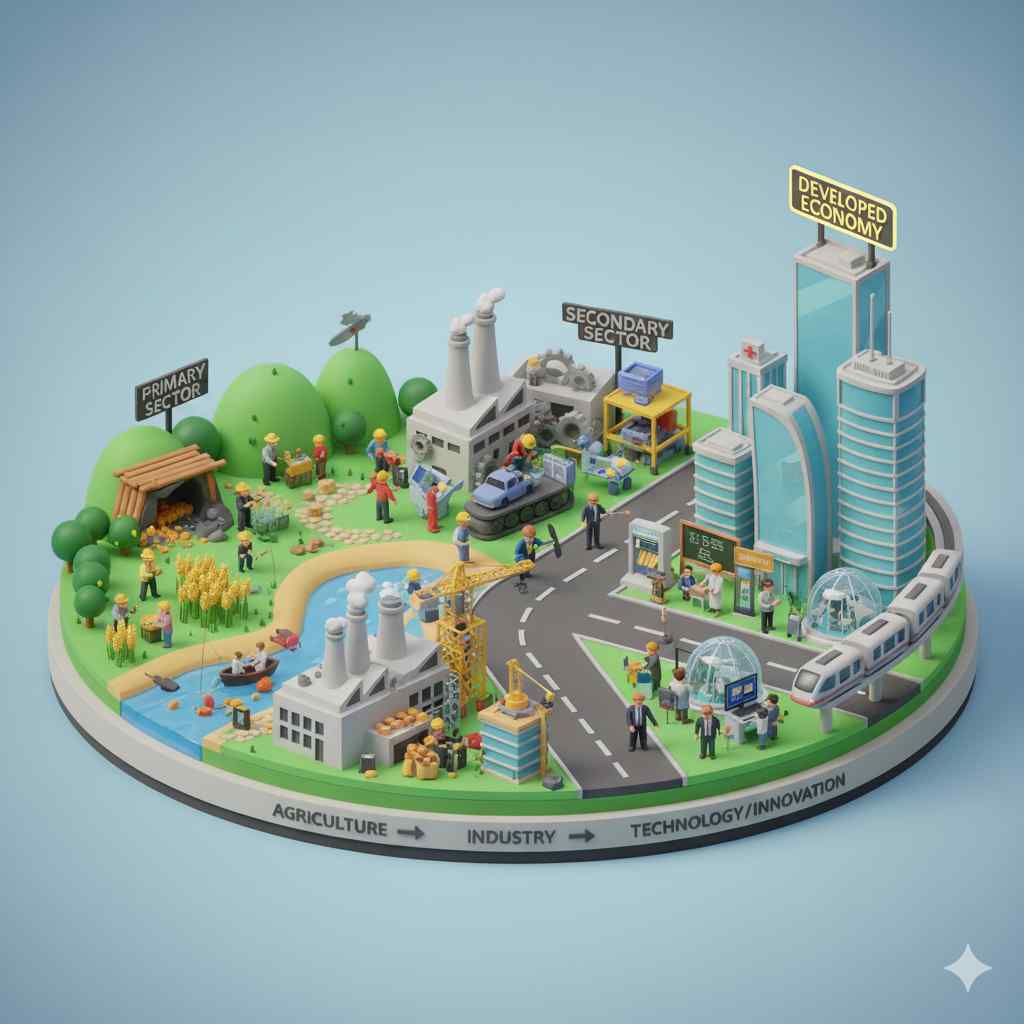
The development stages of an economy are discussed in details below
The first stage – 🌾🐄🌽🦈🍯🪵
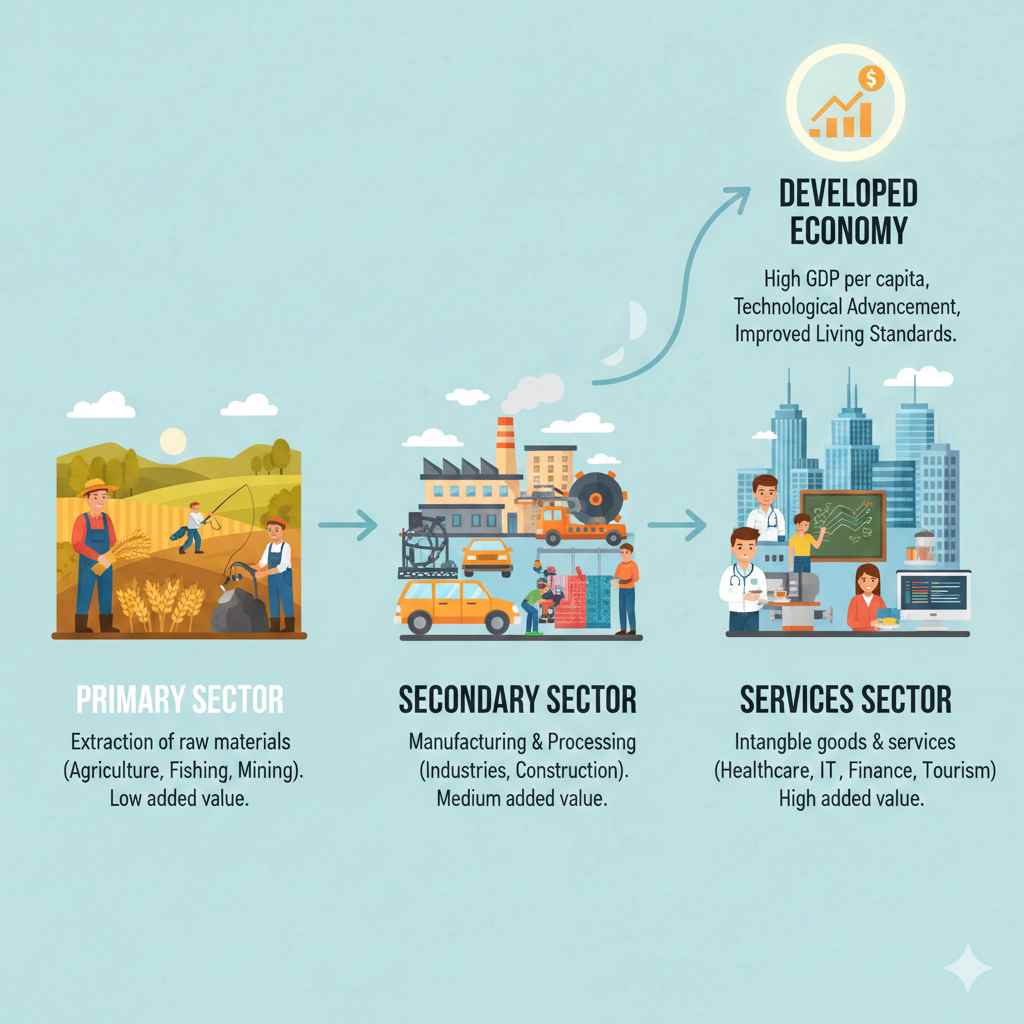
The first stage or we can say, primary stage is related to extraction of natural resources and agriculture. In this early developmental stage of the economy, the majority of the workforce is engaged in agricultural and related activities.
- Activities involved in the primary stage –
- Farming
- Fishing
- Collecting timber, collecting honey, and other natural resources.
- Mining, quarrying
- The population is focused on survival and only works for its needs.
- Almost every country which is now considered as developed/developing economy went through this stage.
What made them progress ?
The new techniques and machines helped to increase production. Once the needs of the population are met, the surplus (more than the need) production made them do its trade. The surplus production can also be processed further to create new products.
The second stage – 🏠🧑🔧🫙🏭🚢🚂
Surplus production, capital inflows, and the availability of labor pave the way for the processing of raw materials and the making of finished goods. Manufacturing of useful things takes place in this second stage.
- Activities involved in the second stage –
- Processing of the raw material – chips from banana, sauce from tomatoes, etc.
- Manufacturing – textile from cotton and other fibers, machines, vehicles, production of electronic items, etc.
- Construction
- Energy production
- The workforce is mostly absorbed in the industry and allied activities after the primary sector.
- It is a more productive sector than the primary one.
- The second stage brings value addition to the raw material of the primary sector.
- This stage causes urbanization, as the industries attract labor to a single place/area.
- The transition from this stage toward the third stage –
- The industrialization increases the incomes of individuals.
- Machines and automation brings in the need for more advance goods and services.
- Technology develops in this stage, which requires more skilled labor.
These things become base for the transition towards the service dominated economy. Industry sector contributes the most to the GDP of the economies in this stage.
The third stage – 💻🏦💳✈️📚👩⚕️
The third stage is the most advanced stage of an economy out of the three stages. When we meet the needs and also progress further, we demand more sophisticated goods and services. The materialistic nature of humans is clearly seen in this stage.
- The service sector activities –
- Trade and logistics
- Education
- Healthcare
- Transport
- Banking, insurance, etc.
- Communication services.
Economies in this stage get their highest contribution to the GDP from the service/tertiary sector.
Let’s understand these stages through an example of a large global economy –
1. The USA (United States of America) –
| Era | Agriculture(Primary sector) | Industry (Secondary sector) | Services (tertiary sector) |
| 1776 | ~70% | ~10% | ~20% |
| 1900 | ~15% | ~30% | ~55% |
| 1950 | ~7% | ~33% | ~60% |
| 2024 | <1% | ~18% | ~81% |
Source = US info website and EBC Financial Group Data
- First stage ➡️ Agrarian era (1776 to 1860s) –
- Almost 90% of the population lived in rural areas.
- Agriculture and primary sector activities contributed around 40%-70% to USA GDP.
- Crops = rice, tobacco, indigo and cotton. Extraction of other natural resources.
- Industry sector was ~10% to 20% of the GDP.
- cottage industries, small iron forges, small scale textile production, etc.
- The shipbuilding industries were also there.
- Service sector contributed almost 10% to 20% to the US GDP.
👇
- 2. Second stage ➡️ The Industrial revolution (1870s – 1945) –
- After internal conflicts, US invested heavily in railway connectivity, oil and steel.
- Industry sector contributed to the US GDP around 30% to 40%.
- Industries = Railways, steel, coal & mining, oil refineries, automobile, electricity generation, etc.
- The share contribution of agriculture sector to the US GDP fall to ~10%.
- Introduction of machines like tractors, pumps, etc. Due to mechanization, industries attracted the extra workforce.
- The tertiary sector (service sector) contributed to the GDP ~30-40%.
- Industrialization resulted into urbanization and these urban centers needed services like utility services, banking, insurance, etc.
Read our article on ➡️ Top 10 Economies (2025)
👇
- 3. Services era (1950s to 2000) –
- The industry sector remained huge but if compared to the contribution to the GDP its share fall and the services sector emerged as the highest contributor.
- The service sector was around 70% of the US GDP.
- Demand for services like education, insurance, finance, entertainment, etc. grew exponentially.
- In the 1960s, the service sector became the largest contributor to the US GDP, replacing the industry sector.
- Manufacturing contributed to the GDP ~10-15%.
- Agriculture and allied sector was almost ~3% or less of the total GDP.
There is further progress of the third stage that is information and technology era. We can say that, it is the ultimate stage of the evolution and development of an economy. The US economy, currently, is in this stage.
- The primary sector contributes less than 1% to the GDP.
- Secondary sector = ~18% of the GDP.
- The tertiary sector = ~80% of the GDP.
This is how economies show a pattern of development, or we can say stages of development, from primary sector domination to service sector domination. The share of the primary sector in the GDP reduces as the economy makes progress. The service sector ultimately dominates the economy, and such an economy is considered a developed economy.
The other prominent examples of large economies that show a similar pattern and stages are China and India. We will discuss their stages of development as well, but in the upcoming posts.
1 thought on “Stages of Development of an Economy : Part 2”