
You don’t need to study economics in college to deal with economics every day. Economics is already a part of your life-whether you like it or not.
At its core, economics is not only about fancy theories, graphs and numbers. It is about understanding how people deal with limited resources while trying to utilize resources to fulfill their needs and desires. This problem is faced by everyone, whether rich or poor, educated or uneducated.
This article explains what economics really is, using simple words & daily examples.
What is economics?
Acharya Chanakya described economics as ‘Arthashastra (अर्थशास्त्र)’ meaning the ‘science of wealth’ (arth). The Arthashastra is crucial for human survival, prosperity of the nation, and to use our limited resources wisely.
Adam Smith explains economics as an inquiry into the nature and causes of the wealth of a nation.
In simplest of terms 👉 economics is the study of how people make choices when they cannot get everything they want.
Difference between economics and economy
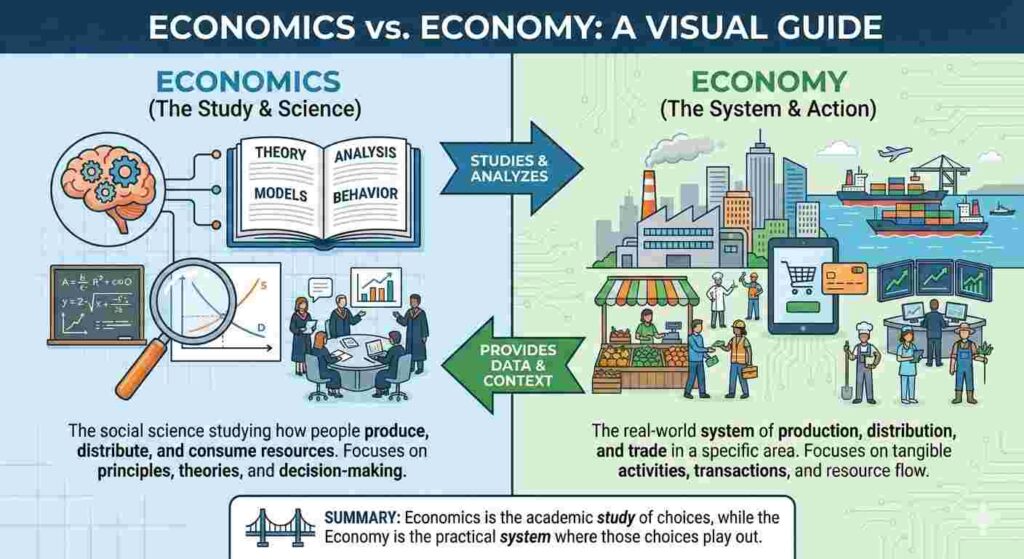
Economics is a social science that has laws, theories, and principles that tell us how limited resources can be efficiently used, while the economy is a system within a specific region that runs/uses these laws and principles. Basically, economics is a set of laws, principles, and theories, and the economy is a practical system (it can be an organization, a private company, especially a country, etc.) that applies these laws and theories.
For example – we say, ‘Indian economy’ and not ‘Indian economics’. Because an economy is the practical application of the laws of economics.
Economics starts with a basic problem
Here is the problem every human faces:
👉 We have limited money but unlimited wants.
You want:
Good food, a better phone, comfortable housing, security for the future, enjoyment today, But your income is limited.
So you must choose: spend or save
This act of choosing is where economics begins. That’s it. Just choices.
A simple real-life example
Suppose you earn ₹25,000 per month. After expenses, you are left with ₹7,000.
Now you have to make a choice :
- Should I save it?
- Should I buy something?
- Should I repay debt?
- or should I invest?
You cannot choose all four options.
The study of such situations👉 limited money/resources, many options/wants — is economics.
Economics is not just about money
Economics is not only about money. It is about decision-making.
Money is just one form of limited resource.
For example:
- You have limited time → how and where do you use it?
- You have limited energy → where do you spend it?
- A government has limited funds → where should it spend?
Why do such problems exists
If resources were unlimited, everyone would have everything and no one would need to choose. Prices of goods and services wouldn’t matter. But resources are limited.
So economics exists to answer these basic questions, like –
- What should be produced?
- How much should be produced?
- Who should get it?
- Who decides all this?
Economics is part of daily life
You may not read books on economics, but economics affects your life every single day. Many people think economics is only about money, but it goes beyond that. Economics also deals with time, effort, skills, and opportunities. When someone chooses to work extra hours instead of resting, or studies one subject instead of another, that is also an economic decision.
Consider a person earning ₹30,000 per month. After paying rent, groceries, electricity bills, transport costs, and other essentials, only a small amount remains. That person must then decide whether to save it, spend it, repay debt, or invest. Since the money is limited, not all options are possible. This situation may feel personal, but it is precisely what economics studies.
Two simple parts of economics
To make economics easier to understand, it is divided into two parts:
- Microeconomics
- Macroeconomics
What is Microeconomics?
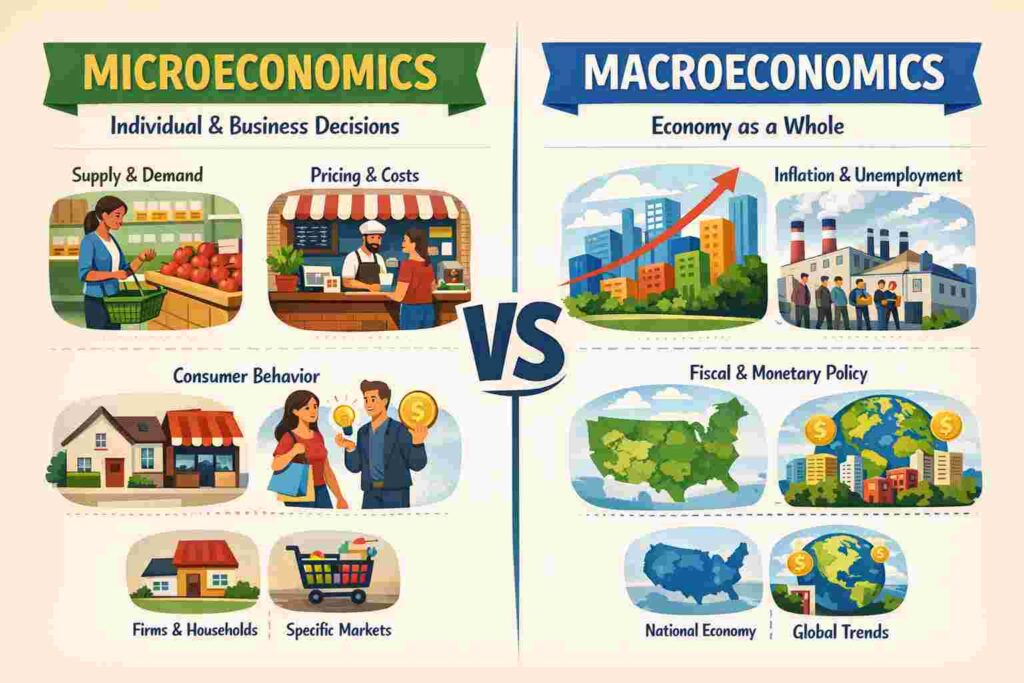
Microeconomics looks at small units and individual decisions.
Microeconomics focuses on and answers questions like :
- Why did this product become expensive?
- Why do people buy more during sales?
- Why do companies pay different salaries?
- Why do some shops earn more than others?
It tries to understand how people make decisions, how prices are formed, and how supply and demand work in specific situations.
Microeconomics in everyday life
You go to a shop to buy a packet of cookies. The price of the packet has increased (that is inflation), so you need to choose: will you buy the same cookies, think of another brand or a smaller packet, or not buy cookies at all?
That decision is also microeconomics.
Simple way to remember Microeconomics
👉 Micro = means small things like retail prices, inflation at ground level, etc. It focuses and studies economic stuff that a normal daily life has.
It deals with:
- income
- expenses
- prices
- jobs, etc.
What is Macroeconomics?
Macroeconomics looks at the economy as a whole. It focuses on bigger things/issues like GDP, global trade, foreign exchange, currency, etc.
Instead of one person or shop, it looks at:
- the entire country
- total income
- total jobs or employment scenario
- total production
Macroeconomics answers questions like:
- Why is inflation rising everywhere?
- Why are jobs hard to find?
- Why does the government borrow money?
- Why does RBI change interest rates?
Macroeconomics in daily life
Suppose:
- prices of food, fuel, and rent – everything increases
- salaries do not increase at the same speed
This is not a personal problem. This is a macroeconomic problem.
Or suppose:
- many companies stop hiring
- unemployment rises
Again, this is not about one person. It is about the whole economy.
Simple way to remember Macroeconomics
It deals with:
- inflation
- GDP (growth)
- unemployment
- government budget
- national policies
- global economic issues
Micro vs Macro – one easy example
Let’s take petrol prices. Same issue but different perspective, different reasons, and different effects.
Microeconomics:
- How does petrol price affect your monthly budget?
- Will you travel less?
- Will you use public transport?
Macroeconomics:
- How does petrol price affect inflation?
- How does it impact transport and goods prices?
- How does it affect the entire economy?
- what are the international reasons for the price hike?
Why both are important for financial literacy
Many people think, “They will only care about their personal finance.” But here’s the truth: You may save well (micro), but high inflation (macro) can reduce your savings value. You may be skilled (micro), but recession, shift in the global trends, etc. (macro) can still affect your job.
- Microeconomics helps you manage your money
- Macroeconomics helps you understand your economic surroundings.
Economics teaches people to think more rationally about money. Instead of reacting emotionally to news headlines, a financially literate person asks better questions and makes better decisions.
Economics Is About Understanding, Not Prediction
Economics does not promise perfect answers or exact predictions. It cannot tell us exactly what will happen tomorrow. What it does offer is clarity. It helps people understand patterns, risks, and consequences. Just like a weather forecast helps us prepare without certainty, economics helps us prepare for economic realities.
Final Thought: Economics Is for Everyone
Economics is not meant only for economists, policymakers, or investors. It is meant for ordinary people trying to live stable and growthful lives. Microeconomics helps us understand our personal financial decisions. Macroeconomics helps us understand the world around us. Together, they form the foundation of financial literacy.
You do not need to master economics to benefit from it. Even a basic understanding can help you avoid poor decisions, reduce financial stress, and make your way towards financial freedom.
2 thoughts on “What Is Economics ?”