Economy and education are two pillars of development. The basis for the development of a country is education; it paves the way for ethical, sustainable economic development. Being the pillars of development, both education and economy are complementary to each other. Economy is all about demand and supply, and the education sector is about the overall development of a human being.
Why do we need to discuss this topic ?
Both education and the economy are, of course, complementary. We learn, and then we need to earn. But most of the time there is a gap between them. A gap between demand and supply: the economy demands new skills and resources for development, and many times the education sector fails to deliver the demanded skills. This gap is due to a simple reason, i.e., how fast we adapt to the required changes. Most of the time the economy adapts faster than the education sector.
The economic sector is sensitive to the on-the-ground changes, as it needs the results as soon as possible. A factory cannot wait for the workers to get a certificate and then do their work. A factory just trains them and gets its work done.
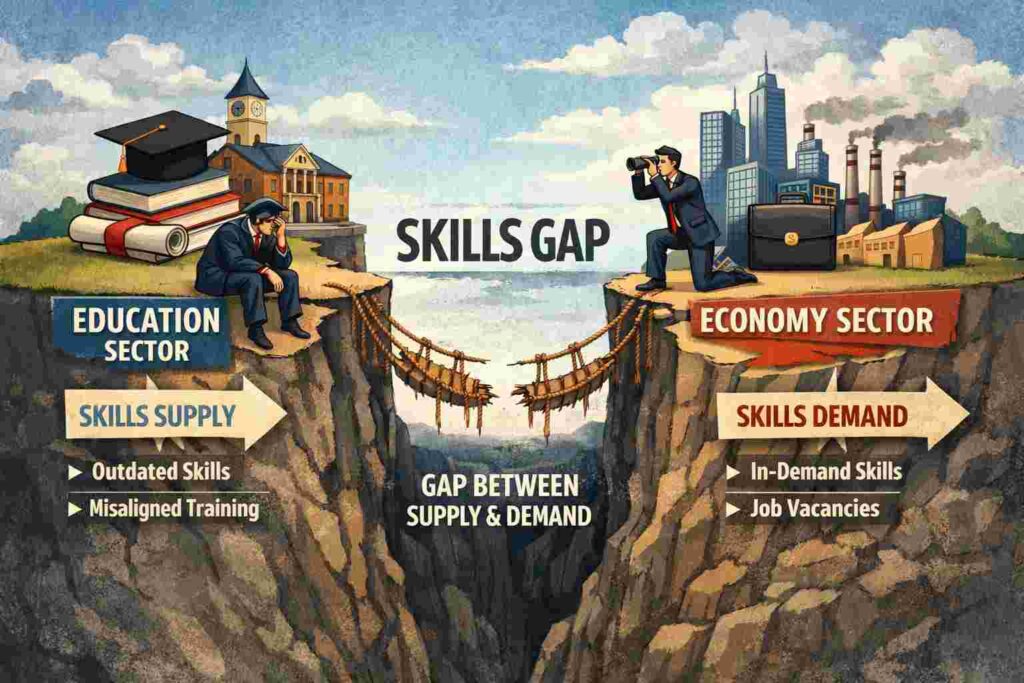
On the other hand, the education sector adapts to the required changes slowly, and the demand generated by the economy gets filled anyway without certificates and all those things. It shows a clear gap between academic output and skills required for industry needs.
And it’s not a modern problem; it has a long history. Even 100 years ago, people did lose their jobs as they failed to adapt to the changes in the economy. For example, the Industrial Revolution (1760-1840) introduced machines to boost industrial production. Many workers lost their jobs, while those who learned how to operate these machines survived the change.
The purpose of education and economy-
education
Learning multiple subjects, getting good marks, passing the exams, and progressing to higher classes are part of the education system. At the end, we get a degree certificate, and based on that, we seek (try to find) employment or earning opportunities. But this is not the core purpose of education. One can earn based on educational qualifications and degrees, but that’s not the core purpose of education or the only purpose of education.
The core purpose of education is to develop wisdom in human beings and make them more aware and conscious about the world. Education is also about developing good values, making our future generations kind and honest; otherwise, we may create more intelligent devils.
Economy
Economy is a system, a system that regulates the resources available to us. A system built to better utilize the limited natural resources. It is the economic system that regulates money; it controls the supply of money. In the modern world, everything is revolving around the economy. The economy is something that defines the strength of a nation in terms of materialistic and tangible achievements.
It’s the economy that gives us money for our work. We earn our living based on what we provide to the economy, and the economy pays us based on the quality of our work. Without incentives, why would anybody work? And without any skills, why would anybody pay?
About education and economy
The demand generated by the economy acts as a trigger for the change. The demand and supply gap is always there in the initial phases of such transitions. Later the required/demanded resources, skills, etc. become a new normal.
- Example:
- Suppose a manufacturing company requires a specialized machine that is currently unavailable. To enhance production, the company aims to develop this machine. Engineers will undertake the task of creating the required machine, potentially facing numerous setbacks. During this development phase, a disparity may arise between demand and supply. Eventually, either the students or the same engineering team successfully constructs the machine. Subsequently, there will be a demand for skilled workers capable of operating the machine. Furthermore, the machine will require regular maintenance, leading to a need for professionals specialized in machine repair.
- Examples of the gap between education and economy
- Industrial Revolution (1860s onwards) –
- It is the best example of the transition period in an economy where we can clearly see the demand-supply gap between learning and on-the-ground changes. The new technology was introduced as the mechanization of the economy started. Handcraft and other traditional production systems became less profitable because of the machines.
- 2. Second Industrial Revolution (1870s onwards) –
- The time of scientific discoveries changed the whole scenario of industrial production. The new research and discoveries lead to mass production. The economy was going through rapid changes, and it obviously created the same gap.
- 3. The digital era (1990s onwards) –
- The introduction of computers made very significant progress. People all over the world struggled a lot to learn these high-tech machines (computers). Initially no syllabus taught how to use and operate the computers. The gap is still wide when it comes to the use of computers. Many students, even working professionals, face struggles using basic computers.
Check the Govt. of India website for skill development ➡️ Skill India Hub
Manufacturing skills required in 2026 ➡️ click here
This is a flow, a cycle; it takes time. But there will always be a gap between demand from the economy and supply from the education sector.
Why ? 👉 Because the economy needs faster actions to deliver output, and it adapts faster than any other sector.
It’s all about how fast we accept and adapt to the changes that support our economic and social development.
We discussed the problem of the gap between education and the economy. What is a potential solution?
The solution is basic but difficult to execute on the ground. 👇
Skill-based economy. And not a degree or certificate-based system.
We will discuss the skill-based economy in a future article.
2 thoughts on “Education and Economy”