

Systematic Investment Plan 📈💰💹
SIP stands for Systematic Investment plan. It is similar to an EMI (Equated Monthly Installments), but the only difference is you don’t need to do it every month compulsorily. It is a strategy you make for your investments in any asset class.
The term SIP is popular in the context of mutual fund investment. When an investor decides to invest her saved money every month, part by part and not in a lump sum way, it is called an SIP. There is no compulsion to invest in mutual funds or any other assets every month. One can invest as it suits their goals and needs.
Read the previous post ➡️ What is a mutual fund ?
How it works ?
The SIP concept is quite simple when it comes to plan your investment. When we plan to invest our money, we need a proper plan which will give us good returns in long term. The SIP is a helpful tool/plan that can easily plan our investment journey.
When we choose to follow a SIP for our investment, we invest our money periodically. It can be monthly investment, or we can choose to invest every three months (i.e. quarterly), or bi-monthly (every two months), etc. There is a lot of flexibility when it comes to the cycle of investment.
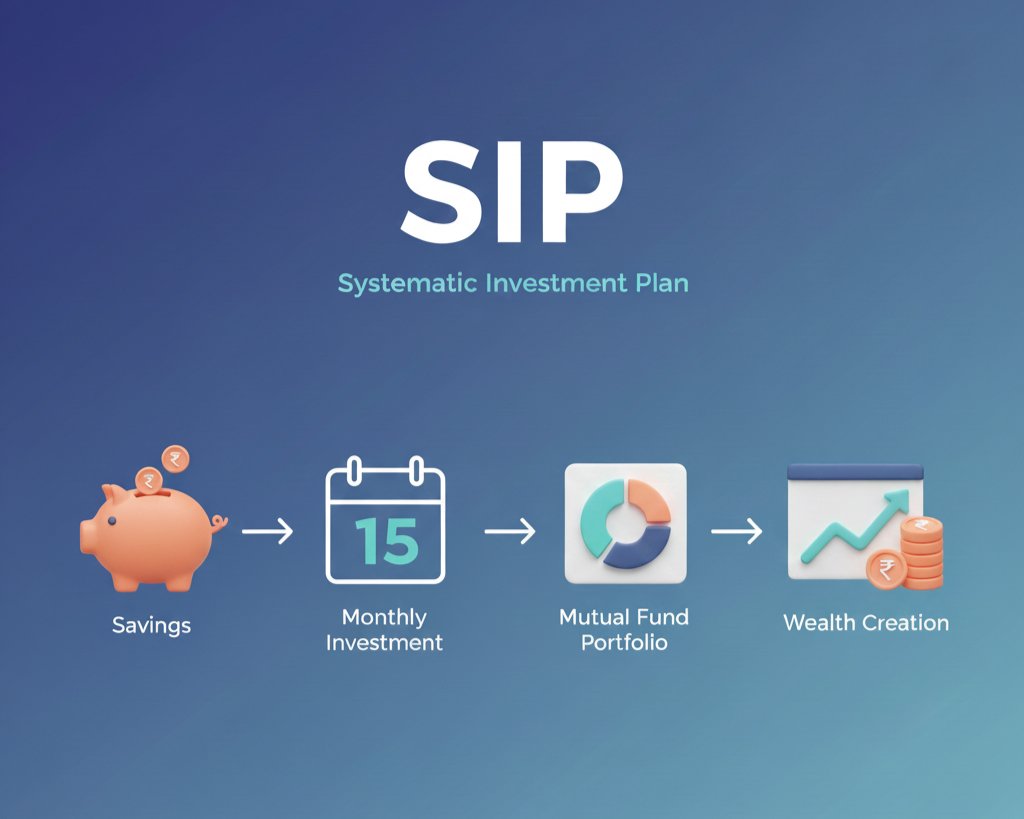
There is no compulsion for consistent and constant investment. In one month you start investing with, let’s say, Rs.1000 and in the very next month you can choose not to invest at all. You can increase or decrease the amount of money as it fits you.
Benefits of SIP (Systematic Investment Plan) 👍
- A systematic investment plan, as the name suggests, is an investment plan that helps us invest our money into different assets systematically.
- We follow a system that channelizes our money in a better asset class.
- By following a system, we eliminate the fluctuations that arise due to our emotional decisions.
- A system so created makes us financially more disciplined. There are fewer chances of skipping a monthly investment if we follow the plan made according to our SIP.
- The one who stays with the plan and follows it religiously makes more money than the one who loses patience and faith.
Also read ⇾ what is SEBI ?
- It is good when you invest a fixed amount of money at a regular interval.
- You buy mutual fund units at both low and high prices and average the value of your investment.
- One cannot time the market every time, so we just invest regularly and try to average the price at which we get returns.
- Example – A person purchased a mutual fund unit at Rs.100 in January. In February, he again invests some money, this time he purchased a unit at Rs.90. In February, he got the unit cheaper than the January.
- This buying at low price is called as ‘averaging’.
- Again, in March he may buy a unit at Rs.110, this will make the average price of all the three units Rs.100.
- This cycle goes on and at the end we get the average price of a unit as the average of all the prices of all the units that have been purchased over the period of time.
- You buy mutual fund units at both low and high prices and average the value of your investment.
- You do not need a very big amount to start investing in stock market or any other asset.
- One can start investing with just Rs.500 or maybe even less, like there are a few SIPs that start with Rs.100 per month only.
- SIP is quite affordable, meaning you can start investing with very small amount of money.
SIP protects us from market volatility 🧱😱🦺🛟
- When you invest in a mutual fund using a SIP, you choose a safer way of investment. The fund managers are experts, who manage these large funds. These experts make investment decisions based on their market research.
- The investment through SIP keeps us safe from market volatilities. We get average or a bit more returns as we keep averaging by regular investment of a fixed amount. By doing SIP we generate average returns, not very high or very low returns.
- An individual investor may get higher returns than those who invest through a SIP. But, he may get very low returns compared to the one who invested through a SIP if market conditions did not favor.
The good returns through – SIP
Usually, mutual funds generate better returns than the traditional investments in long term. In my opinion, traditional investments are – fixed deposits (FDs), savings accounts in banks, gold, real estate, etc.
Usually, the fixed rate of returns are not promised by a mutual fund house. Some fund house may promise a fixed return in case they invest in a debt bond like Govt securities, corporate bonds, etc.
Some mutual funds have generated more than 15% return annually. The top-rated mutual funds generally gave 12% to 15% annual returns in the long term, of course there is no guarantee of this by any fund house. The historical data supports these numbers.
Visit and check mutual fund official list ➡️ SEBI website
Check here the historical data ➡️ Money Control
SIP is a better way of planning your investment. The flexibility and affordability makes it a way better option than any other investments. One can start investing from anywhere using internet and a smartphone or a computer. You only need to be at least 18 years old in India to start investing in MFs or stock market.
So, start your investment journey with SIP in MF.
2 thoughts on “What is SIP ?”